Tap a dollar bill on the table and it doesn’t ring. It used to. For most of American history a dollar was a claim on a set amount of gold, and the government was obliged to hand the gold over on demand.
Today a dollar is just a claim on everyone else’s agreement that it’s worth something. That switch came in two steps, the second on a Sunday night in August 1971.
This is the story of when the U.S. got off the gold standard, told through the house, the one purchase almost everyone eventually makes.
What the gold standard was
Under the gold standard, paper money was a receipt. The U.S. fixed the dollar’s value at about $20.67 per ounce of gold and promised to convert in either direction on demand. Because the money supply was tied to the gold on hand, the government couldn’t print its way out of trouble.
That discipline had a real cost. Prices fell through the late 1800s, bank panics kept hitting savers, and the Great Depression turned the system from a guarantee into something closer to a straitjacket.
The two dates that matter
If you ask when the U.S. left gold, most people say 1971. Right, but it was a two-step exit.
1933. In the depths of the Depression, President Roosevelt banned private gold ownership by executive order and, in January 1934, reset the price at $35 an ounce. From then on, Americans couldn’t swap dollars for gold. Only foreign governments could.
August 15, 1971. For years the U.S. had printed dollars to pay for Vietnam, domestic programs, and a growing trade gap, and the surplus dollars piling up abroad were being cashed in for gold at the bargain $35 price. On a Sunday night, Richard Nixon announced the dollar no longer traded for gold, period. The “gold window” shut and never reopened. The post-war system that pegged world currencies to the dollar, and the dollar to gold, was effectively over.
The half-century before, and after
Here’s the median home, from 50 years before that announcement to now:
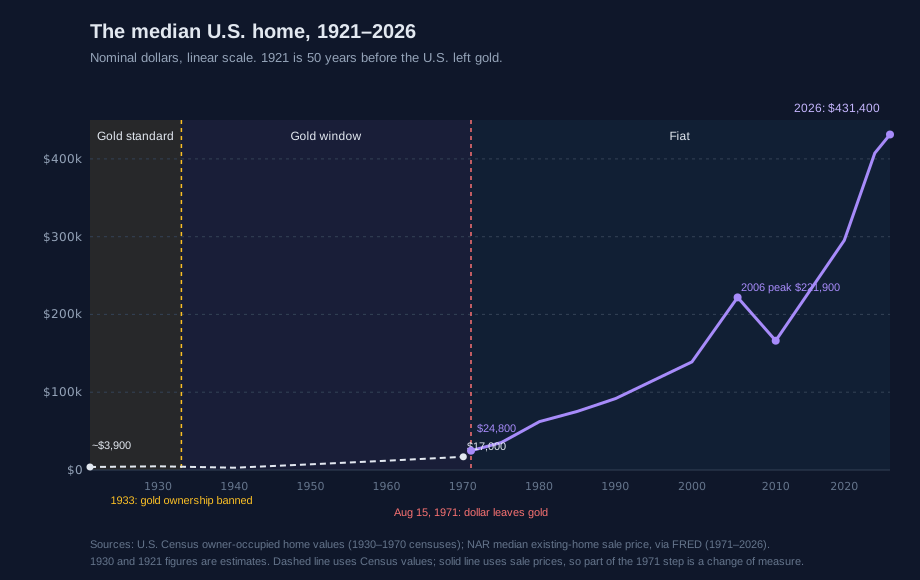
Read left to right. For the 50 years under a gold-anchored dollar, the median home moved from roughly $3,900 to about $25,000. The 1930s actually fell. The line is nearly horizontal compared with what comes next.
After 1971 it goes vertical. $47,200 in 1980. $139,000 in 2000. $295,300 in 2020. $431,400 in mid-2026.
One honest caveat: the two halves of the chart are measured differently. The early figures are Census owner estimates of what homes were worth. From 1971 on, they’re the actual median existing-home sale price realtors report. Part of the step at 1971 is a change of ruler, not a change in prices. The pattern holds either way.
Four dates, four price tags
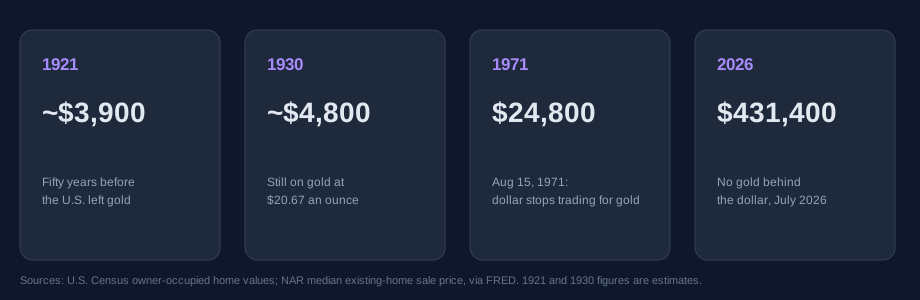
Under gold, the median home sat in the low thousands of dollars for decades. The day the gold window closed, it was $24,800. Fifty-five years later it’s about seventeen times that.
What the anchor’s removal did and didn’t do
The straightforward version: a gold-backed dollar kept the purchasing power of money roughly stable, and a fiat dollar doesn’t. Strip the constraint on printing money and the ceiling on nominal prices goes with it. The 1970s delivered double-digit inflation, mortgage rates near 16%, and a rough decade for anyone buying on a loan. Nobody has agreed on how many dollars a house is worth since.
The honest version: correlation isn’t causation. The post-1971 climb also rests on easier mortgages, suburbs, zoning that limits supply, bigger houses, and people treating their home as an investment rather than a bill. The 2008 crash is the counterweight to the myth that homes only go up. Even that, the worst housing collapse in a century, only took the median down roughly 25% from peak to trough, and prices resumed climbing anyway. Adjusted for inflation, the 1980s were flat and the 2000s through the crash were a lost decade for real gains.
What this means for your money
The flat-left era was the anomaly. Fifty years of near-level prices looks like the natural order if you grew up in the 2010s, but it ended in 1971.
The price tag almost never goes down. Even the crash of 2008 only knocked the median back a few years of gains.
Real value is what matters, and inflation is the current underneath it. A 3% inflation rate halves a dollar’s buying power in about 24 years, the Rule of 72 math from How Money Actually Works. When someone tells you a house will be worth $1.2 million in 2040, ask what that means in today’s dollars. The inflation-adjusted answer is the only one worth planning around.