Somewhere near you tonight, a grocery store is selling rye bread at $4.29. Getting it to the shelf took a wheat farmer, a miller, a baker, two wholesalers, a truck driver, a labeling printer, and a bank that trusted the chain, none of them taking orders from a central office. Nobody decided your street should have bread on a Tuesday. It just shows up — which is the invisible hand at work.
The invisible hand is coordination nobody designed. People chase their own interests, prices adjust, and a working whole emerges. It’s one of the most useful ideas in economics, and one of the most misquoted, usually as a slogan for things Smith never said.
What Adam Smith actually said
In 1776 The Wealth of Nations used the phrase exactly once, about a merchant who just wants to make money:
He intends only his own gain, and he is in this, as in many other cases, led by an invisible hand to promote an end which was no part of his intention.
The point isn’t that greed is secretly good. The merchant serves his customers because that’s how he gets paid. Seventeen years earlier, in The Theory of Moral Sentiments, his book on ethics, he used the same phrase about a landlord: one stomach can only hold so much, so the rest of his wealth reaches everyone who works for him.
For a century and a half, that was the whole idea. Then it became a bumper sticker for whatever the market did. Smith would have been puzzled: his own book warns that merchants “conspire against the public” and rig prices whenever they get the chance.
How the mechanism works: prices are information
A cold snap in Florida kills part of the orange crop. Oranges get scarcer, so the price of orange juice jumps.
You buy less, or switch to apples, and the apple price creeps up. The grocery orders fewer cartons. The packer cuts back. Next spring a farmer plants more acres, because the price told her where the money is. Nobody ordered any single step; the price was the instruction, and no one had to explain it.
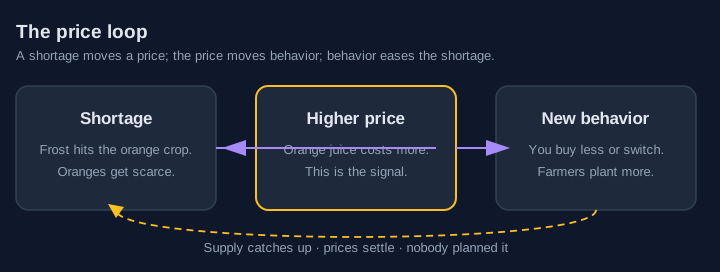
F. A. Hayek called prices a “system of telecommunications” in his 1945 essay. No planner could gather what millions of individuals know. Yet a raw material gets scarce, and tens of thousands of people economize without being told why. A price is the whole economy’s knowledge folded into one number.
Smith made the same point about dinner: we expect it “not from the benevolence of the butcher, the brewer, or the baker, but from their regard to their own interest.” It sounds cynical. The butcher serves you because that’s how he earns his living.
What the invisible hand does not do
The mechanism is real, and so are its limits.
Fairness was never part of the bargain. Prices reflect what people can pay and what’s counted. They coordinate the world they’re handed, and if people start unequal, prices show it.
It misses costs that land outside the transaction. A plant that burns cheap coal leaves its smoke in the neighborhood, not on its own ledger. The price omits that cost, so everyone steers as if the smoke didn’t exist. The invisible hand isn’t broken here; it’s steering by a map with a river left out.
It needs real competition. A monopoly raises prices and keeps them there, serving itself without the pressure that turns self-interest into service. The hand depends on rival sellers and buyers who can walk away.
Smith’s first book argued for sympathy and ethics. The invisible hand explains how an economy holds together; it says nothing about whether the harness is kind.
What the invisible hand means for your money
The practical version is one sentence: prices are information. Your salary offer is the market’s estimate of your skills, fair or not. Your APR says pay this off first; your mortgage rate says buy now or wait. None is a verdict on you; each is the market’s best guess.
Do: automate. A broad, low-cost index fund is a claim on the whole coordination apparatus at once. Prices allocate capital across every company; you collect the average and keep buying monthly. The market already prices what millions of strangers know. Feed your own numbers into the compound calculator to see what patience earns.
Don’t: outsmart prices. By the time a headline reaches your phone, the price has already moved, and the coordinated price is the hardest opponent you’ll ever have. That’s the whole argument in my piece on why most modern investors still lose money, and it’s why interest rates are the price of money: one number prices thousands of future decisions at once. You can’t beat that number, so don’t try.
When a deal promises returns the market doesn’t offer, ask what the price is hiding. When a platform earns on your activity instead of your portfolio, the incentive is broken and the mechanism stops serving you, as it does at apps built to make you trade.
The working belief
The invisible hand isn’t a promise or a villain. It’s a description of how a society with no central order still gets bread on shelves, oranges into juice, and savings into companies that need them.
Ride the coordination in an index fund, and when a price looks too good to be true, ask who’s paying the cost the tag doesn’t show.
You don’t need a smarter move. You need a patient one.