Everyone has heard it from a parent, a coworker, or a real estate agent: a home is the best investment you’ll ever make. Buy as soon as you can, they say, and in twenty years you’ll thank yourself.
That advice is built on a past that really was kind to homeowners. And that’s the problem: you can’t buy in the past. You buy in the future, and the future is unknown.
This is the honest version of the buy-vs-rent question for your primary residence, not rental properties, just the roof over your head. The short answer: owning is still worth it for most of us. It is not a guaranteed great investment, and thinking about it now can save you from a mistake you’d carry for decades.
Why the past looked so good
Nowhere is “past performance is not the future” more tempting to ignore than in a neighborhood with a for-sale sign on the lawn.
The run from the early 2000s to the peak of the 2020s was extraordinary by historical standards. Mortgage rates fell from around 7% to around 3%, and a monthly payment suddenly bought far more house. Easy credit, a generation of people moving to suburbs, and a once-in-a-lifetime wave of first-time buyers all pushed prices up together.
Leverage did the heavy lifting. With 20% down, a 5% rise in your home’s value is a 25% rise on your money. That’s the machine that made big piles of home equity in the last twenty years, and it works in reverse: a flat decade with 5x leverage is a lost decade on a big piece of your balance sheet.
Rates drove the party, and rates have nowhere near as far to fall. Today’s 6.5% mortgage, not 3%, is the more realistic starting point for the next twenty years. That doesn’t mean prices fall; it means the tailwind is spent.
Five buyers, one honest price tag
So what does owning earn you? The fair way to test it is to compare two people with the same money and the same monthly payment.
Person A buys the same real house every time: a home that cost $200,000 in 2005 dollars, so the sticker price tracks inflation from $200,000 in 2005 to $333,000 in 2025. Person A puts 20% down with a 30-year fixed mortgage in each of five different years: 2005, 2010, 2015, 2020, and 2025. We sell every house today.
Person B rents the equivalent place in the same years and pays the same monthly bill. For the owner that’s principal, interest, taxes, and insurance; for the renter it’s rent. Each down payment, from $40,000 to $67,000, goes into a plain S&P 500 index fund instead.
The model assumes a lot in the owner’s favor. Rent runs exactly as high as a full PITI payment. The roof never needs replacing. Taxes never spike. Selling costs don’t exist. Even so, here’s what each ended up with:
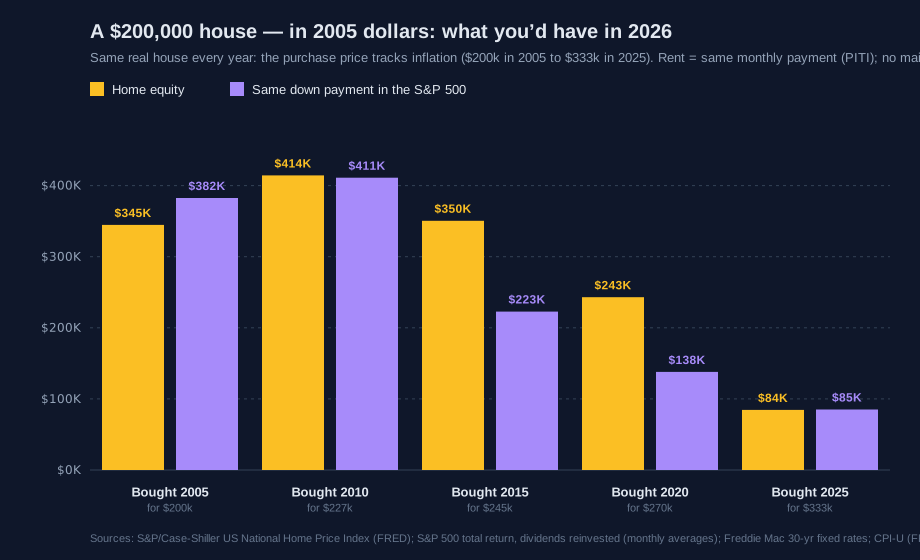
Walk those bars left to right:
- 2005, bought the top of the boom: $345,000 in home equity from a $40,000 down payment is a serious number. The S&P 500 did better anyway, at $382,000. Those 21 years included a crash so severe it took a decade to recover from.
- 2010, bought the bottom: $414,000 vs $411,000. A dead heat, decided by a rounding error.
- 2015: $350,000 vs $223,000. The house won clearly on a long recovery and a low-rate mortgage.
- 2020: $243,000 vs $138,000. The luckiest buyers in American history walked in on a pandemic price surge and a 3% mortgage. That lottery does not exist twice.
- 2025, buying today: $84,000 vs $85,000. Eighteen months in, it’s a coin flip, and the home number hasn’t paid its ~6% in selling costs yet.
The house ends ahead in 2010, 2015, and 2020, stocks in 2005 and 2025, and the 2010 and 2025 rows are decided by a rounding error. Every winner caught genuinely unusual conditions. Owning beat stocks mostly by luck of timing, not by law of nature.
The model is stacked in the house’s favor and it’s still a wash
Everything the chart left out favors the buyer.
- Rent equals PITI. In many expensive markets today, renting a comparable home costs less than buying it, which tips the scale further toward renting.
- No maintenance. Real life spends roughly 1-2% of the home’s value a year on upkeep. Call it $3,000 to $6,000 a year on our example house.
- No transaction costs. Buying carries closing costs of a few percent. Selling carries agent commissions of ~5-6%. On a $400,000 sale that’s $25,000 or more that never shows up in an equity number.
- No liquidity. You can’t sell 2% of a house when you need cash. Selling takes months, and you’ll be judged by the market on that exact day. Index funds sell at noon.
- No diversification. A house is one asset in one city, ruled by one county’s taxes, one local economy, and one zip code’s insurance market. Calling your most concentrated holding “your biggest asset” doesn’t make the concentration healthy.
And we still haven’t counted the benefits that legally belong to owners: the capital-gains exclusion on up to $500,000 of profit and the mortgage interest deduction. Throw those in, and it’s a wash that breaks roughly even with a grumpy-looking index fund that never needed a new roof.
The hidden costs that change the whole math
For a renter, the rent is the most they’ll ever pay each month. For an owner, the PITI payment is the least.
Your principal and interest really are fixed in nominal dollars, and over 30 years that’s real protection against rent inflation. But taxes and insurance sit on top, and those climb over time, sometimes violently.
California is the current warning label. After years of devastating fires, premiums in some zip codes have jumped by double digits annually, when you can get coverage at all. Carriers have pulled out of entire regions, pushing home owners onto state-backed “FAIR plan” policies that cost more and cover less. Your town can go from reasonably insurable to nearly uninsurable faster than a ballot measure or a wildfire season. When that happens, the “fixed payment” wasn’t fixed, and the house is only as valuable as the ability to insure what’s in it.
The payment at closing is the floor of your cost, not the ceiling. The ceiling is a new furnace, a roof, an assessment, or an insurance renewal you can’t believe.
The real case for renting
Renting gets treated as the default for people who can’t afford to buy. But flexibility is worth something real, and it compounds.
Life changes in ways you can’t schedule. A relationship, a job across town or across the country, a company that relocates you, a parent who needs you nearby, a layoff that shrinks the budget. A renter responds to all of those in a matter of months to a year. An owner is a seller in a market they didn’t choose, at a time they didn’t choose, paying the costs of leaving.
Right-sizing works the same way. When the kids leave or your needs shrink, a renter moves to something smaller. An owner can’t easily “sell the spare bedrooms.” And the down payment that would have been locked up in bricks stays liquid, usable for an emergency, a business, or a better investment while it grows.
Nobody can predict which of these will matter to you, and that’s the point. Renting converts a future you can’t see into options instead of obligations.
When buying genuinely wins
None of this means renting is right for you. For most people, owning a home is still a fine decision, and there are times when it’s clearly the right one.
Buying wins when your career and family are firmly planted in one place and you’re confident you’ll stay for a long stretch. It wins when you can genuinely afford the payment without stretching: not what a lender approves, but what fits comfortably in the budget you actually live on. It wins when you want complete control, which renting can never give you. You can knock down walls, repaint, re-landscape, upgrade to the house that fits your life instead of asking a landlord for permission.
There’s a quieter benefit too: for people who wouldn’t save otherwise, a mortgage does the saving for them. Every month, some of your payment quietly becomes yours.
What the past taught me
I once bought a house at the very top of the market. It was 2007, in the run-up to the worst housing crash in a century, and my equity stayed negative for years. On paper, I’d have done better renting and putting my down payment in an index fund.
I’d still buy that house again. Not because the math eventually worked out. It took a long time to. Because that house was the home where I got to spend real time with my dad before he passed away the next year, and he got to see his son as a homeowner and a provider, settled. No investment return can buy that moment back.
Choosing that house was probably the second-best decision I’ve made, right after choosing my wife. That isn’t a financial statement. The best reasons to buy a home have nothing to do with appreciation.
The bottom line
Buy a home because you want a home: a fixed base for your family, a place you control, roots you choose to grow. If your life is planted and your budget is ready, buy, and don’t lose sleep over the math.
Just don’t buy because someone promised you a guaranteed great investment. The honest numbers say roughly a wash once you count what a house really costs, and houses with leverage can hurt badly when the timing is unlucky. Stocks are the better growth engine; a house is the better place to live.
For most of us, owning is still worth it: for the life it makes possible, not the returns it promises. Frame it that way, and you’ll make the decision correctly either way.